Postal futures
The 10 Technologies That Will Reinvent the Post
The next postal revolution won’t be about delivering parcels faster. It will be about building an intelligent physical network that can sense, think, act, transact—and eventually defend itself.
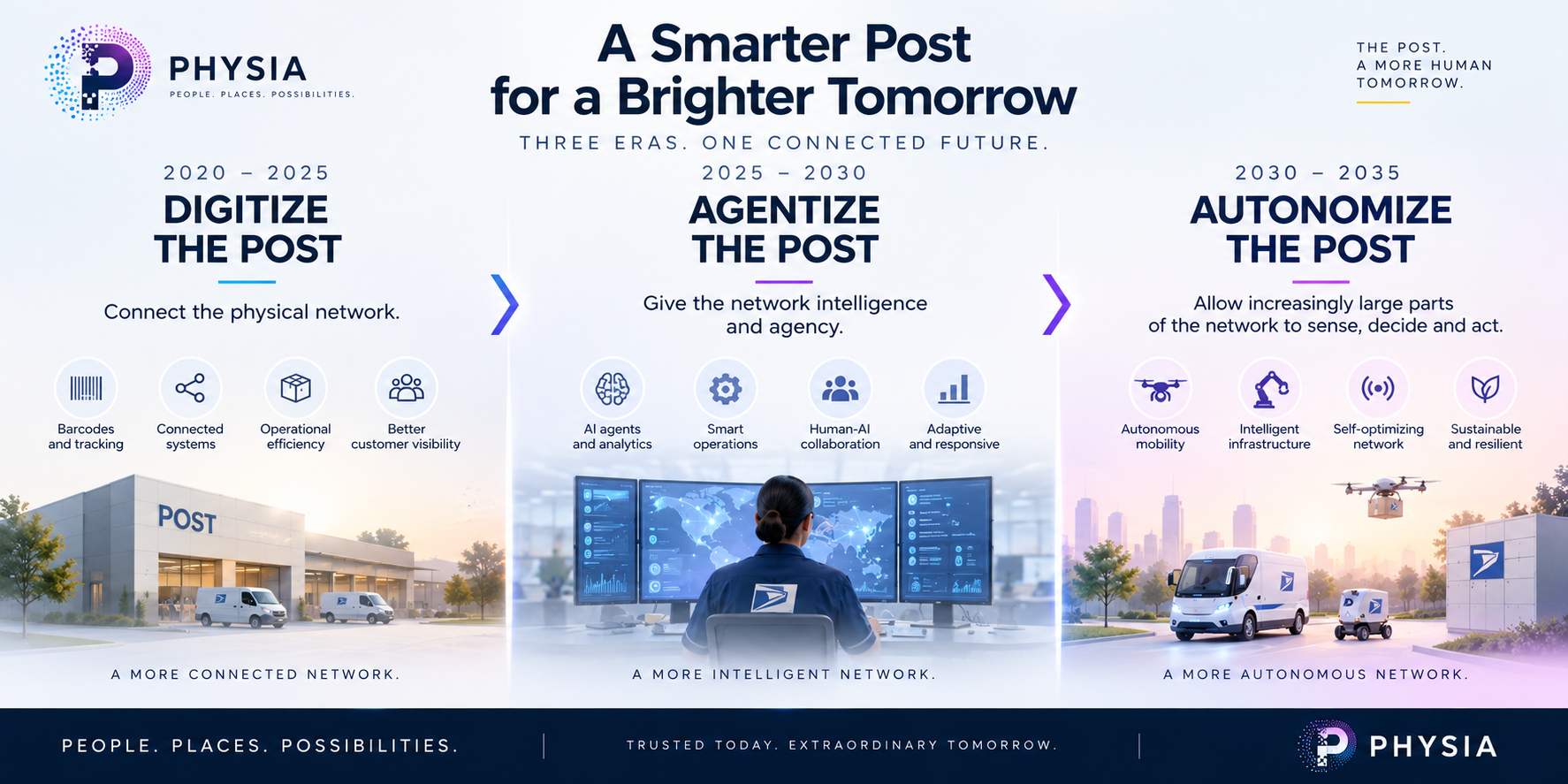
For most of the past 30 years, postal technology has meant digitization.
Barcodes replaced handwriting. Scanners replaced paper manifests. Optimization software improved routes. Track-and-trace gave customers visibility. Automated sorting moved parcels through increasingly sophisticated facilities.
All of this was important. But it was essentially about putting a digital layer over a physical network.
The next transformation will be fundamentally different.
AI is escaping the screen. It is evolving beyond chat.
It is moving into warehouses, vehicles, robots, cameras, energy systems and the physical infrastructure of commerce. At the same time, AI itself is evolving from something we ask questions of into something capable of planning, deciding and acting.
For postal operators, however, the important question isn’t which technologies are fashionable.
What happens when these technologies converge inside one of the world’s largest physical networks?
The answer could be much more consequential than another generation of automation.
This is the stuff that could reinvent the Post.
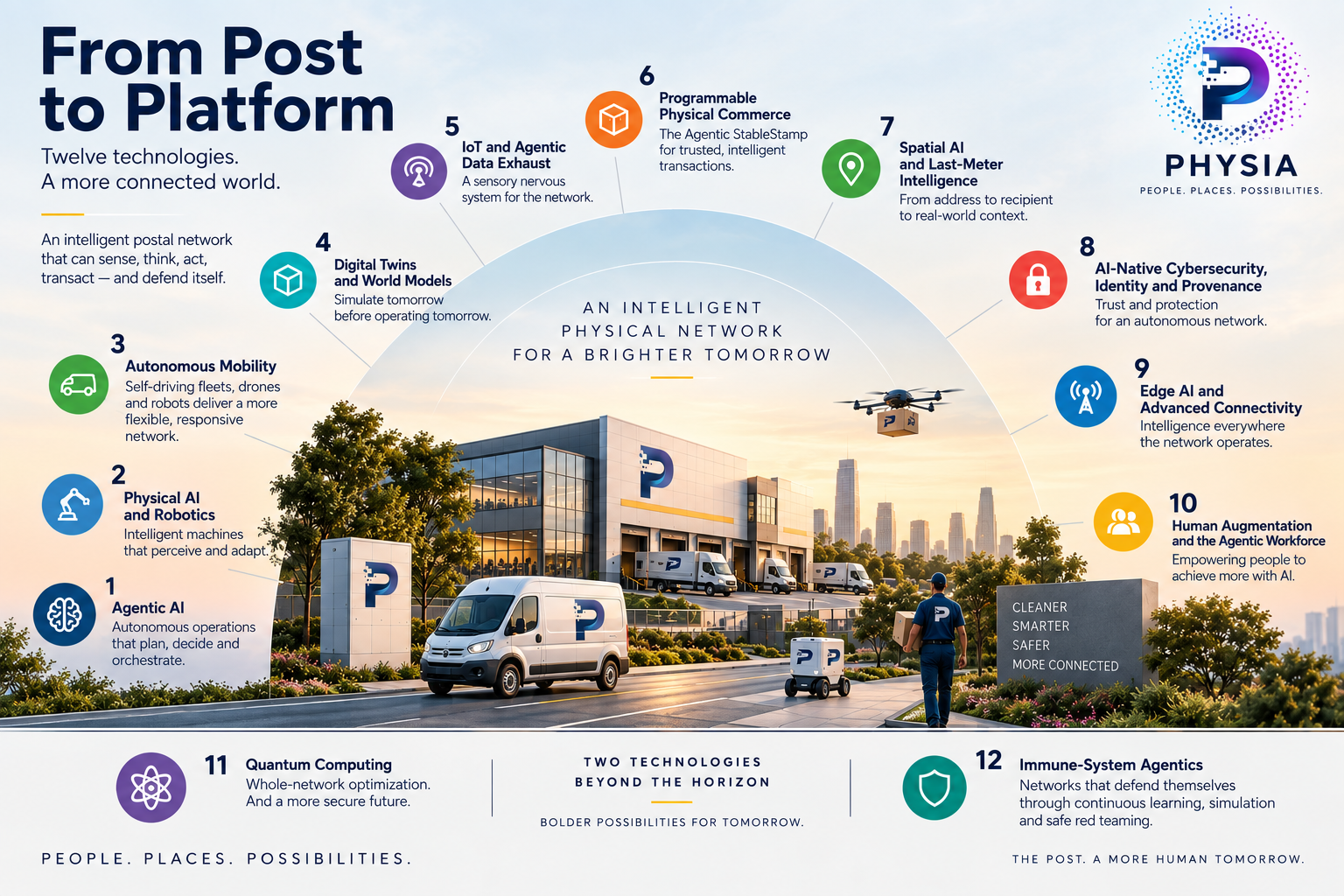
1. Agentic AI: From AI That Answers to AI That Acts
Generative AI gave us machines that could write, analyze and converse. Agentic AI gives those machines something considerably more important: agency.
Agents can pursue goals, make plans, use software, interact with other agents, evaluate outcomes and change their behavior.
Imagine thousands of specialized agents operating across a postal network. One forecasts parcel volumes. Another reallocates capacity. Another reroutes vehicles. Another manages customs exceptions. Another communicates with customers. Others negotiate machine availability, energy consumption or delivery windows.
The Post gradually moves from software-assisted operations to an agentically orchestrated network. This may ultimately prove more important than generative AI itself.
2. Physical AI and Intelligent Robotics
Now give AI a body.
Traditional industrial robots excel in tightly controlled environments. Physical AI is beginning to produce machines capable of perceiving their surroundings, reasoning about them and adapting their behavior.
For postal operations, that means increasingly intelligent robotic induction, unloading, sorting, pallet handling and autonomous movement through facilities.
The longer-term opportunity is not simply a warehouse containing more robots. It is a warehouse in which robots, sorting equipment, cameras, humans and AI agents collectively operate as a self-optimizing physical system.
3. Autonomous Mobility—and the Battery Revolution
The delivery network itself is becoming programmable. Autonomous vans, sidewalk robots, drones and software-defined fleets will increasingly allow transportation capacity to be orchestrated dynamically.
But one of the most consequential technologies behind this revolution may be far less glamorous: the battery. Solid-state and lithium-metal batteries promise potentially significant improvements in energy density, charging and safety. Sodium-ion technology could create lower-cost alternatives for some vehicles and stationary storage. Lithium-sulfur remains a potentially important longer-term technology if its engineering challenges can be overcome.
The implications go far beyond vehicles that drive farther. Higher energy density makes drones and delivery robots more useful. Faster charging reduces fleet downtime. Cheaper stationary batteries allow depots to store renewable electricity. Vehicle-to-grid systems could eventually turn thousands of postal vehicles into distributed energy assets.
Better batteries won’t simply improve the postal vehicle. They could redesign postal infrastructure.
Today: Depot → Charger → Vehicle → Route → Depot
Tomorrow: Energy Hub → Autonomous Fleet → Robots → Drones → Microhubs → Smart Lockers
4. Digital Twins and World Models
Before an intelligent network can act intelligently, it needs a model of itself.
Imagine a continuously updated digital representation of the postal network incorporating parcels, depots, machines, routes, vehicles, employees, weather, traffic, capacity and demand. AI can then experiment against that model before changing the physical world.
Instead of asking what happened yesterday, management can increasingly ask: What is likely to happen tomorrow—and what happens if we change it?
The Post begins simulating tomorrow before operating tomorrow.
Sense → Model → Simulate → Decide → Act → Learn
5. IoT and Agentic Data Exhaust: The Postal Nervous System
Postal networks already generate extraordinary quantities of data. The next step is turning that exhaust into intelligence.
Every parcel scan, locker opening, vehicle movement, robot decision, sorting event, failed delivery, customer interaction and machine vibration can become part of a continuous operational signal. Add inexpensive sensors, cameras and connected infrastructure and the network begins acquiring something resembling a nervous system.
But collecting more data isn’t the breakthrough. The breakthrough occurs when AI agents can continuously interpret and act upon it.
Data stops being something primarily analyzed afterward. It becomes the sensory apparatus through which the network understands itself.
Billions of events → Shared context → Machine reasoning → Autonomous action
6. Programmable Physical Commerce: The Agentic StableStamp
For centuries, the stamp has been remarkably simple. It essentially says: this object has permission to move through the postal system. What if the stamp became intelligent?
A future postal identifier could become a machine-readable commerce credential containing—or securely referencing—identity, provenance, permissions, customs information, payment instructions, sustainability data and delivery state. And crucially, AI agents could query it.
The tracking number evolves into an intelligent object that participates in commerce.
This could transform track-and-trace into something considerably larger: an interoperability and trust layer for programmable physical commerce.
Stablecoins settle money. StableStamp settles commerce.
7. Spatial AI and Last-Meter Intelligence
Knowing that a parcel has reached an address isn’t the same as understanding where it needs to go.
Computer vision, multimodal AI and geospatial intelligence are beginning to give machines contextual understanding of physical environments. AI could identify entrances, lockers, loading zones, hazards, parcel damage, accessibility constraints and appropriate safe-drop locations.
Eventually the system isn’t merely tracking a parcel’s coordinates. It understands the environment surrounding the delivery.
Track-and-trace becomes last-meter intelligence.
Address → Building → Entrance → Recipient → Context
8. AI-Native Cybersecurity, Identity and Provenance
As postal networks become more autonomous, cybersecurity changes character.
When software merely stores information, a cyberattack compromises information. When software controls robots, vehicles, parcels and financial transactions, a cyberattack can compromise the physical world.
Postal operators will therefore need trustworthy identities not merely for humans, but potentially for every participant in the network. Every autonomous action increasingly needs identity, authorization, provenance and accountability.
Cybersecurity becomes an operational safety system.
Human ↔ Agent ↔ Robot ↔ Vehicle ↔ Parcel ↔ Organization
9. Edge AI and Advanced Connectivity
A robot navigating a depot cannot always wait for a cloud server to tell it what to do. Neither can an autonomous vehicle, smart locker or high-speed sorting system.
Physical AI therefore pushes intelligence toward the edge. Some intelligence remains centralized. Some sits inside facilities. Some moves inside vehicles and machines.
The postal network consequently becomes something unexpected: a geographically distributed computing platform.
Cloud AI + Edge AI + IoT + 5G/6G + Wi-Fi + Fiber + Satellite
10. Human Augmentation and the Agentic Workforce
The most important interface in this new system may still be the human being.
AI copilots, knowledge agents, autonomous coding, multilingual assistants, simulation-based training and wearable computing could dramatically increase what one employee can accomplish.
That changes the economics of talent. Organizations won’t simply ask how many people they employ. They’ll ask how much capability each person can orchestrate through AI.
Reskilling therefore stops being primarily an HR initiative. It becomes core technology infrastructure.
Worker → AI-Augmented Worker → Agent Supervisor → Orchestrator
Beyond the horizon
And two technologies beyond the horizon
Ten technologies are enough to transform the next decade. But two additional developments could eventually challenge some of the assumptions underneath them.
11. Quantum Computing: What If We Could Optimize the Whole Network?
Postal networks represent extraordinary combinatorial optimization problems. Millions of parcels must interact with destinations, vehicles, employees, sorting machines, service commitments, weather, traffic and capacity constraints. Today’s systems necessarily decompose much of this complexity.
Quantum computing could eventually contribute to solving certain optimization and simulation problems that become prohibitively difficult for conventional computing. Practical quantum advantage for large-scale logistics optimization has not yet been demonstrated, so this belongs firmly on the horizon rather than tomorrow’s IT budget.
What happens when we can optimize the postal network as a system rather than optimizing its pieces?
There is also a nearer-term issue: quantum-resistant security. Postal organizations developing long-lived identity and commerce infrastructure should already be thinking about post-quantum cryptography.
12. Immune-System Agentics: What If the Network Could Defend Itself?
Perhaps the strangest idea on this list comes from biology rather than computer science.
The human immune system doesn’t wait for a central security operations center to tell it something is wrong. It is constantly sensing its surroundings, distinguishing healthy behavior from anomalies and responding locally when it detects a threat. It can isolate a problem, eliminate it and retain a memory of what happened so that it responds more effectively the next time.
That is a useful model for an AI-native postal network. Specialized defensive agents could continuously examine the network’s data exhaust and learn what normal behavior looks like across agents, transactions, parcels, identities, robots, vehicles and instructions. When something appears suspicious, the system could challenge it, restrict its permissions or contain it before the problem spreads.
Security would no longer follow a purely linear process of detection, alerting, human investigation and response. It would become a more continuous cycle of sensing, challenging, containing, recovering and learning.
This does not mean removing people from the loop. It means giving them a system that can act quickly and proportionately while preserving human oversight for consequential decisions. Within tightly governed boundaries, controlled adversarial agents could probe the network for fraud, cybersecurity vulnerabilities, manipulated AI agents and unexpected interactions before hostile actors discover them.
As the Post becomes more autonomous, its defenses may need to become autonomous as well.
The bigger picture
The Real Revolution Is Convergence
It is tempting to treat these as 12 separate technology trends, each with its own business case, implementation plan and specialist team. But that framing misses the larger story. Their real significance lies in the way they reinforce one another.
Agentic AI provides the intelligence. Digital twins give that intelligence a model of the world to reason about. IoT, spatial intelligence and agentic data exhaust provide the sensory input. StableStamp, identity and provenance create a trust layer for interactions between people, agents, machines and objects. Cybersecurity and defensive agents provide something like an immune system. Robots, autonomous vehicles and drones provide the physical means to act. Batteries provide the energy, while edge computing and advanced connectivity allow decisions to be made wherever the work is happening.
Humans remain central, but their role changes. They increasingly become the people who set goals, establish boundaries, supervise agents and orchestrate the capabilities of the whole system.
Put these pieces together and the postal network starts to look less like a collection of sorting centers, vehicles and IT systems. It begins to resemble an intelligent organism for physical commerce: sensing what is happening across its environment, building a model of that environment, reasoning about what should happen next, mobilizing physical assets, authenticating transactions, protecting itself from threats and learning from every interaction.
The most important question for postal leaders, therefore, isn’t which of these technologies they should buy. It is what kind of organization they are becoming when all of these technologies converge.
For hundreds of years, the Post connected people. Then it connected addresses. Then it connected physical commerce. Its next role could be larger still.
As AI makes commerce increasingly autonomous, the world will need trusted infrastructure connecting digital intelligence to physical reality—identity to objects, agents to machines, payments to delivery, and decisions to action.
Few institutions possess the physical reach, trusted identity, logistics infrastructure and daily connection to households and businesses that postal networks already have. That creates an extraordinary strategic possibility.
The Post doesn’t have to become merely a better delivery network. It can become the operating system for intelligent physical commerce.
Sources: Technology outlooks from McKinsey, Gartner, Deloitte, the World Economic Forum and DHL point broadly in the same direction, spanning agentic AI, robotics, mobility, advanced connectivity, cybersecurity, specialized computing and energy.